

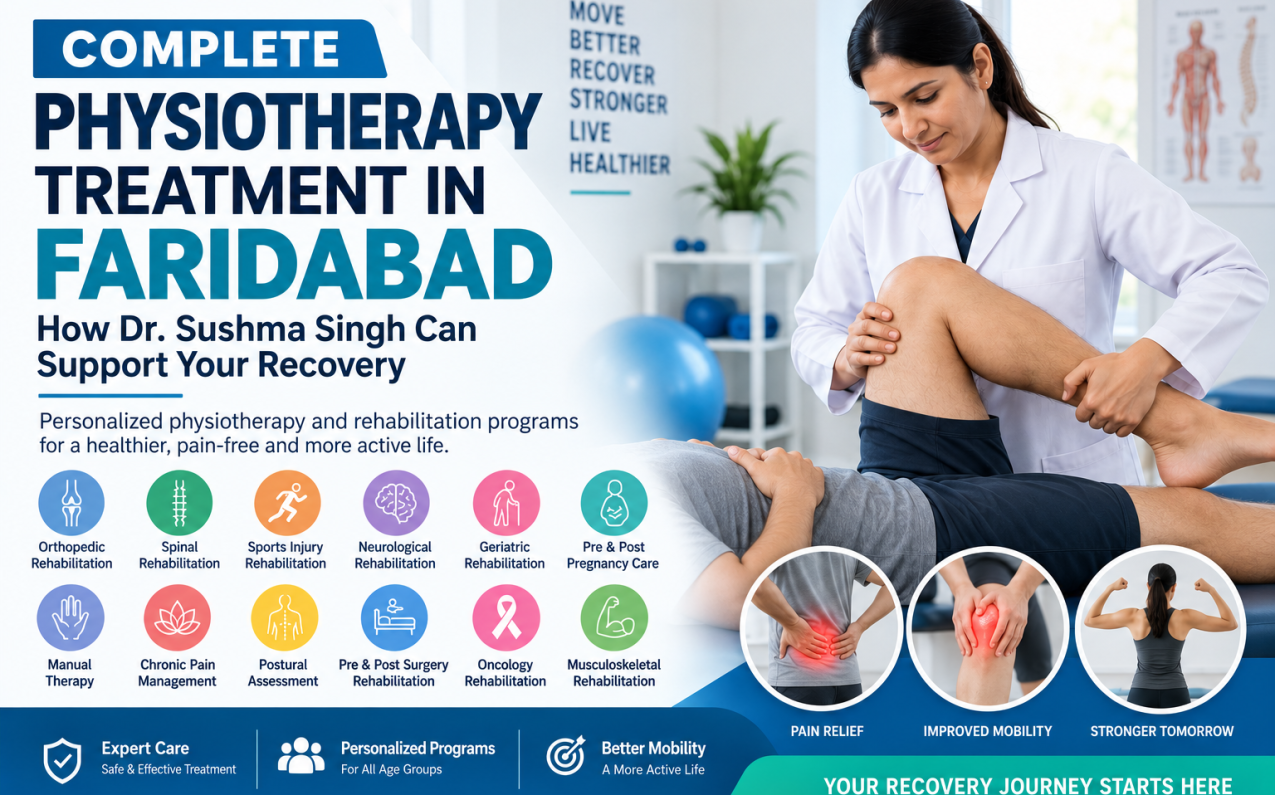
Pain, stiffness, weakness, injury, or difficulty in movement can affect almost every aspect of everyday life. Whether you are dealing with persistent back pain, recovering from surgery, managing a sports injury, experiencing joint problems, or trying to regain mobility after a neurological condition, the right physiotherapy approach can play an important role in your recovery.
Physiotherapy is not limited to treating pain. A comprehensive physiotherapy program can focus on improving movement, strength, flexibility, balance, coordination, posture, physical endurance, and functional independence.
For people searching for complete physiotherapy treatment in Faridabad, choosing a clinic that offers personalized assessment and rehabilitation is important. MBM Physiotherapy in Faridabad provides a range of physiotherapy and rehabilitation services designed to address different physical conditions and recovery requirements.
Under the guidance of Dr. Sushma Singh, patients can receive individualized physiotherapy programs based on their symptoms, physical condition, lifestyle, and recovery goals.
In this blog, we will discuss different types of physiotherapy treatment, common conditions that may benefit from rehabilitation, what you can expect during treatment, and how Dr. Sushma Singh at MBM Physiotherapy can support your recovery journey.
What Is Physiotherapy?
Physiotherapy is a healthcare discipline focused on helping individuals improve movement and physical function.
A physiotherapist evaluates the patient’s physical condition and develops an appropriate treatment and rehabilitation plan.
Depending on the individual’s condition, physiotherapy may include:
- Therapeutic exercises
- Manual therapy
- Mobility exercises
- Strengthening exercises
- Stretching and flexibility training
- Balance training
- Gait training
- Postural assessment
- Functional rehabilitation
- Pain management strategies
- Home exercise programs
- Patient education
The treatment approach depends on the underlying condition, severity of symptoms, medical history, physical capabilities, and rehabilitation goals.
The purpose is to help patients move more comfortably, improve physical capacity, and regain confidence in performing everyday activities.
Why Is Physiotherapy Important for Recovery?
Many injuries and medical conditions can affect the body’s ability to move normally.
For example, after surgery, a patient may experience weakness and stiffness. Following a sports injury, an athlete may lose strength, balance, or confidence. Someone with chronic back pain may avoid physical activity, resulting in reduced conditioning over time.
Physiotherapy can address these limitations through a structured rehabilitation process.
A well-designed program may help with:
Pain Management
Appropriate physiotherapy techniques and exercises may help reduce discomfort and improve movement.
Mobility
Restricted movement can be gradually addressed through suitable mobility exercises and therapeutic techniques.
Strength
Progressive strengthening can help rebuild muscles weakened by injury, illness, surgery, or inactivity.
Balance
Balance exercises can improve stability and confidence during movement.
Flexibility
Appropriate stretching and mobility work can help address restrictions affecting movement.
Functional Recovery
The ultimate objective is often to help patients return to activities that are important to them, including work, exercise, walking, sports, and daily household activities.
Complete Physiotherapy Treatment in Faridabad
Different patients require different rehabilitation approaches. At MBM Physiotherapy, treatment can be tailored according to the individual’s condition and goals.
Some of the major physiotherapy and rehabilitation services include the following.
1. Orthopedic Rehabilitation
Orthopedic rehabilitation focuses on conditions affecting the bones, joints, muscles, tendons, ligaments, and other musculoskeletal structures.
Patients may require orthopedic physiotherapy after:
- Fractures
- Joint injuries
- Muscle injuries
- Ligament injuries
- Joint replacement
- Orthopedic surgery
- Arthritis
- Frozen shoulder
- Knee problems
- Hip problems
- Shoulder problems
Treatment may involve mobility exercises, progressive strengthening, balance training, manual therapy where appropriate, and functional rehabilitation.
The rehabilitation program is adjusted as the patient’s strength and mobility improve.
2. Spinal Rehabilitation
Back and neck problems are among the common reasons people seek physiotherapy.
Spinal rehabilitation may be appropriate for certain patients experiencing:
- Lower back pain
- Neck pain
- Spinal stiffness
- Sciatica symptoms
- Disc-related problems
- Postural problems
- Spinal injuries
- Recovery after spinal surgery
A spinal rehabilitation program may focus on:
- Spinal mobility
- Core strengthening
- Postural training
- Muscle strengthening
- Flexibility
- Functional movement
- Activity modification
The goal is to help patients improve movement and physical function while managing their symptoms appropriately.
3. Sports Injury Rehabilitation
Sports injuries can occur during professional sports, gym workouts, running, recreational activities, or even occasional exercise.
Common sports injuries include:
- Ankle sprains
- Knee injuries
- ACL injuries
- Muscle strains
- Ligament injuries
- Hamstring injuries
- Shoulder injuries
- Tennis elbow
- Achilles tendon problems
Sports rehabilitation should generally progress gradually.
The early stage may focus on controlling symptoms and restoring basic movement. Later stages can include strengthening, balance, coordination, functional exercises, and sport-specific training.
The goal is to help athletes safely return to their desired level of activity.
4. Neurological Rehabilitation
Neurological conditions can affect strength, coordination, balance, walking, and independence.
Physiotherapy can form an important component of rehabilitation for certain neurological conditions.
Examples include:
- Stroke
- Parkinson’s disease
- Spinal cord injuries
- Brain injuries
- Multiple sclerosis
- Other neurological conditions affecting movement
Treatment may include:
- Gait training
- Balance exercises
- Mobility training
- Strengthening
- Coordination exercises
- Functional activities
The rehabilitation plan is adapted to the patient’s abilities and goals.
5. Geriatric Rehabilitation
Older adults may experience changes in strength, flexibility, balance, and mobility.
These changes can sometimes affect independence and increase difficulty with everyday activities.
Geriatric rehabilitation can focus on:
- Strength improvement
- Balance
- Walking ability
- Mobility
- Flexibility
- Fall-risk reduction
- Functional independence
Physiotherapy may be particularly useful during recovery after surgery, fractures, joint problems, or periods of reduced physical activity.
The goal is to help older adults maintain or regain safe and functional movement.
6. Musculoskeletal Rehabilitation
Musculoskeletal rehabilitation focuses on problems affecting muscles, joints, bones, tendons, and ligaments.
Patients may experience:
- Muscle pain
- Joint pain
- Stiffness
- Reduced mobility
- Weakness
- Repetitive strain
- Sports-related injuries
Treatment can combine active exercises with other appropriate physiotherapy techniques.
Progressive rehabilitation helps patients gradually improve physical capacity.
7. Chronic Pain Management
Living with persistent pain can be physically and emotionally challenging.
Chronic pain may affect:
- Sleep
- Work
- Exercise
- Walking
- Household activities
- Social activities
- Overall quality of life
Physiotherapy-based chronic pain management may include therapeutic exercises, mobility training, strengthening, activity modification, manual therapy where appropriate, and education.
The objective is not simply to focus on pain intensity but also to improve physical function and help patients manage their condition.
Persistent pain should be appropriately evaluated to identify potential underlying causes.
8. Manual Therapy
Manual therapy involves hands-on techniques that may be used as part of physiotherapy for selected musculoskeletal conditions.
Depending on the patient’s assessment, manual techniques may be used to address:
- Joint stiffness
- Muscle tension
- Soft-tissue restrictions
- Reduced mobility
- Movement limitations
Manual therapy may provide short-term symptom relief for some conditions, but active rehabilitation and exercises are often important for longer-term functional improvement.
9. Postural Assessment & Training
Modern lifestyles often involve prolonged sitting, computer work, smartphone use, and repetitive activities.
These habits may contribute to discomfort or movement limitations in some individuals.
Postural assessment may consider:
- Head and neck position
- Shoulder alignment
- Spinal position
- Pelvic position
- Sitting posture
- Standing posture
- Functional movement
Postural training may then include appropriate exercises and advice about movement habits, workplace ergonomics, and activity breaks.
The goal is not to maintain one rigid posture throughout the day but to develop healthier movement habits and avoid prolonged positions that aggravate symptoms.
10. Pre- & Post-Surgery Rehabilitation
Rehabilitation may be valuable both before and after certain surgical procedures.
Pre-Surgery Rehabilitation
Prehabilitation may help patients prepare physically for surgery by working on strength, mobility, exercise tolerance, and functional capacity when appropriate.
Post-Surgery Rehabilitation
After surgery, rehabilitation can help patients gradually regain:
- Mobility
- Strength
- Balance
- Walking ability
- Functional independence
Examples include rehabilitation following:
- Knee replacement
- Hip replacement
- Shoulder surgery
- Ligament surgery
- Fracture surgery
- Spinal surgery
Treatment should always follow the surgeon’s recommendations and any specific precautions associated with the procedure.
11. Pre- & Post-Pregnancy Physiotherapy
Pregnancy causes significant changes in posture, body mechanics, muscle function, and physical demands.
Appropriate physiotherapy guidance during pregnancy may focus on:
- Mobility
- Strength
- Postural awareness
- Pelvic-floor function
- Comfortable movement
- Preparation for physical demands
After delivery, rehabilitation may focus on gradually restoring strength, mobility, core function, and physical confidence.
Every pregnancy and postpartum recovery is different, so exercises should be individualized and performed according to appropriate professional guidance.
12. Oncology Rehabilitation
Cancer and its treatment can sometimes affect physical strength, endurance, mobility, balance, and functional capacity.
Oncology rehabilitation aims to support appropriate physical function during or after cancer treatment.
Depending on the individual’s medical condition, physiotherapy may focus on:
- Mobility
- Strength
- Functional independence
- Physical conditioning
- Recovery after surgery
- Managing physical limitations associated with treatment
Oncology rehabilitation should be coordinated with the patient’s oncology and medical care team.
How Dr. Sushma Singh Can Support Your Recovery
One of the most important aspects of physiotherapy is understanding that every patient is different.
Dr. Sushma Singh at MBM Physiotherapy can use an individualized approach to understand a patient’s symptoms, physical limitations, lifestyle, and goals.
The rehabilitation process may begin with an assessment covering areas such as:
- Medical history
- Current symptoms
- Pain characteristics
- Range of motion
- Muscle strength
- Flexibility
- Balance
- Posture
- Walking pattern
- Functional limitations
- Activity level
Based on the findings, an appropriate treatment and rehabilitation plan can be developed.
Personalized Physiotherapy Instead of a One-Size-Fits-All Approach
A generic exercise routine may not be appropriate for everyone.
For example, a patient recovering from knee replacement may need gradual mobility and strength training, while an athlete recovering from an ACL injury may eventually require advanced functional and sport-specific exercises.
Similarly, an older adult with balance difficulties may require a very different rehabilitation approach from a young person with a muscle strain.
Personalized physiotherapy considers these differences.
Treatment can be progressively modified according to:
- Recovery stage
- Exercise tolerance
- Strength
- Mobility
- Pain response
- Functional ability
- Personal goals
What Can You Expect During a Physiotherapy Session?
While every appointment can be different, a typical physiotherapy journey may involve several stages.
Step 1: Consultation
The physiotherapist discusses your symptoms, medical history, lifestyle, and concerns.
Step 2: Assessment
Physical movement, strength, mobility, balance, posture, and functional ability may be evaluated.
Step 3: Treatment Plan
An individualized plan is developed based on the assessment.
Step 4: Physiotherapy Treatment
Depending on your condition, this may involve exercises, manual techniques, mobility work, strengthening, balance training, or functional rehabilitation.
Step 5: Home Exercise Guidance
You may receive exercises or activity recommendations to continue working on your recovery between sessions.
Step 6: Progress Review
Your response to treatment can be assessed, and the program can be modified accordingly.
The Role of Therapeutic Exercise in Physiotherapy
Exercise is one of the most important components of many rehabilitation programs.
Depending on the condition, exercises may focus on:
Strength
Building muscle capacity and supporting joint stability.
Mobility
Improving comfortable movement.
Flexibility
Addressing appropriate areas of restriction.
Balance
Improving stability and coordination.
Endurance
Increasing the ability to perform physical activities.
Functional Movement
Preparing the body for real-life tasks.
Exercise intensity should be progressed gradually rather than increased suddenly.
Why Consistency Matters in Physiotherapy
Physiotherapy is a process rather than a single event.
A patient may feel some improvement after a few sessions, but sustainable functional improvement often requires consistent participation.
Patients can support their rehabilitation by:
- Following their exercise program
- Attending recommended sessions
- Communicating changes in symptoms
- Avoiding unnecessary overexertion
- Staying appropriately active
- Following professional recommendations
Your physiotherapist can modify the program if an exercise is too difficult, too easy, or unsuitable.
When Should You Consider Physiotherapy?
You may consider professional physiotherapy assessment if you experience:
- Persistent back pain
- Neck pain
- Joint pain
- Muscle weakness
- Reduced mobility
- Repeated sports injuries
- Difficulty walking
- Balance problems
- Post-surgical limitations
- Postural problems
- Reduced physical activity due to pain
- Difficulty returning to exercise or sports
You don’t necessarily need to wait until symptoms become severe before seeking professional advice.
Physiotherapy for Pain Relief vs. Long-Term Recovery
Pain relief can be an important part of treatment, but rehabilitation should often go beyond temporary symptom management.
For example, if someone experiences recurring knee pain, simply reducing the pain may not address underlying strength, mobility, balance, or movement limitations.
A comprehensive rehabilitation program may therefore focus on both:
Symptom management + Functional improvement
This approach can help patients understand their condition and participate more actively in their recovery.
How Physiotherapy Can Help Improve Quality of Life
Improved physical function can have a positive effect on everyday life.
Being able to walk comfortably, climb stairs, perform household tasks, exercise, work, or participate in hobbies can improve confidence and independence.
Physiotherapy may help patients work toward these goals by improving:
- Movement
- Strength
- Balance
- Flexibility
- Physical endurance
- Functional capacity
The specific outcome depends on the individual’s condition and response to rehabilitation.
Why Choose MBM Physiotherapy in Faridabad?
For people searching for physiotherapy treatment in Faridabad, choosing a clinic that understands different rehabilitation requirements is important.
MBM Physiotherapy focuses on:
Personalized Care
Treatment programs are designed around individual needs rather than using the same routine for everyone.
Multiple Rehabilitation Services
Patients can access physiotherapy services covering orthopedic, spinal, sports, neurological, geriatric, musculoskeletal, chronic pain, post-surgical, postural, oncology, and women’s health rehabilitation.
Progressive Treatment
Exercises and treatment approaches can be modified as the patient improves.
Patient Education
Understanding your condition and learning appropriate movement strategies can help you participate more confidently in recovery.
Functional Rehabilitation
Treatment focuses on helping patients improve meaningful everyday activities rather than focusing only on isolated symptoms.
Tips for Maintaining Better Physical Health
Physiotherapy can support recovery, but maintaining healthy movement habits can also be important.
Consider:
Stay Physically Active
Regular appropriate physical activity can help maintain strength and mobility.
Take Breaks from Prolonged Sitting
Change positions regularly, especially during computer-based work.
Strengthen Your Body
A suitable strengthening program can support muscles and joints.
Maintain Mobility
Regular mobility exercises can help maintain comfortable movement.
Use Proper Technique
Whether lifting weights, exercising, working, or performing household activities, appropriate movement technique matters.
Don’t Ignore Persistent Symptoms
Recurring or worsening pain should be evaluated rather than repeatedly ignored.
Frequently Asked Questions
What is the best physiotherapy treatment for pain?
There is no single treatment that is best for every type of pain. The appropriate approach depends on the underlying condition, symptoms, medical history, and physical assessment.
How many physiotherapy sessions will I need?
The number of sessions varies from person to person. It depends on the condition, severity, recovery goals, response to treatment, and progress.
Can physiotherapy help after surgery?
Yes. Physiotherapy is commonly used as part of rehabilitation following many types of surgery, provided treatment follows the surgeon’s recommendations.
Can physiotherapy help with chronic back pain?
Physiotherapy may help appropriate patients manage chronic back pain by addressing strength, mobility, movement, physical conditioning, and functional limitations.
Is manual therapy enough for recovery?
Manual therapy can be useful for selected conditions, but active rehabilitation and therapeutic exercises are often important components of long-term functional recovery.
Can physiotherapy help prevent sports injuries?
A suitable program addressing strength, mobility, balance, movement control, and conditioning may help address modifiable factors associated with injury risk.
Is physiotherapy suitable for older adults?
Yes. Physiotherapy can help older adults work on strength, mobility, balance, walking, and functional independence.
Can I continue exercising during physiotherapy?
In many cases, appropriately modified activity is part of rehabilitation. However, exercise should be selected according to the individual’s condition and recovery stage.
Conclusion
Finding the right physiotherapy treatment in Faridabad can be an important step toward improving movement, managing pain, rebuilding strength, and returning to daily activities.
Physiotherapy is much more than a temporary approach to pain relief. A comprehensive rehabilitation program can address mobility, strength, flexibility, balance, posture, coordination, functional movement, and physical confidence.
At MBM Physiotherapy, Faridabad, Dr. Sushma Singh provides personalized physiotherapy and rehabilitation programs designed around individual patient needs and recovery goals.
From orthopedic and spinal rehabilitation to sports injury recovery, neurological rehabilitation, geriatric physiotherapy, chronic pain management, manual therapy, postural training, pre- and post-surgery rehabilitation, oncology rehabilitation, and pregnancy-related physiotherapy, MBM Physiotherapy offers a broad range of rehabilitation services.
If pain, injury, weakness, stiffness, or reduced mobility is affecting your daily life, professional assessment can help determine an appropriate course of action.
Remember, recovery is different for every person. There is no universal treatment or guaranteed cure, but with appropriate assessment, consistent rehabilitation, and professional guidance, many patients can work toward better movement and improved physical function.
Dr. Sushma Singh and the team at MBM Physiotherapy, Faridabad, can support you through your rehabilitation journey with personalized care focused on helping you move better, regain strength, and work toward your individual recovery goals.